Installing a fiber line may sound straightforward until the route stretches into the far reaches of urban and rural California. Long infrastructure corridors can cross established rights-of-way, public lands, sensitive biological habitats, cultural resources, waterways, and areas governed by different agencies.
That’s part of the challenge Soar Environmental Consulting is addressing through its work on California’s Middle Mile Broadband Initiative. SOAR is providing environmental compliance and resource management support for aerial and subterranean fiber-optic infrastructure across geographically varied portions of the state.
The state’s middle-mile network is designed to provide open-access infrastructure to extend high-speed broadband service to unserved and underserved communities.
For agencies, utilities, contractors, and infrastructure owners, the project also provides a useful example of what environmental work entails when a construction program spans diverse resource conditions and regulatory jurisdictions.
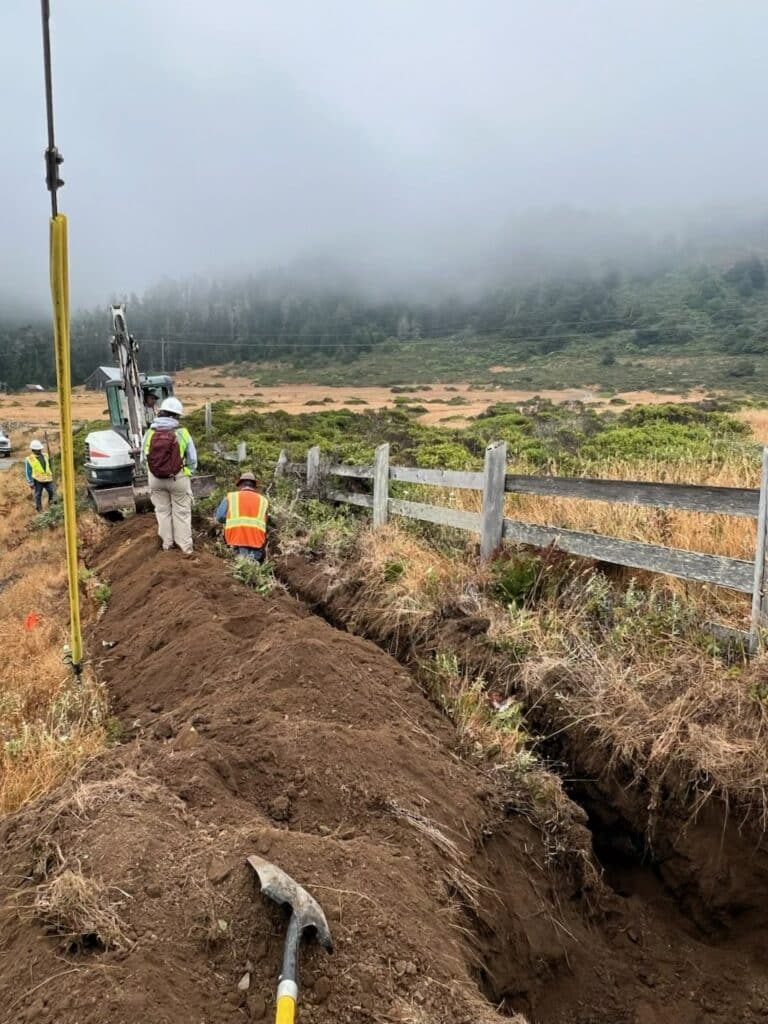
Workers trenching and a Soar archaeologist monitoring ahead of laying conduit and fiber line on the Northern California Coast
Why the Broadband Middle Mile Creates a Different Environmental Challenge
A single development site gives an environmental team a defined footprint. A Broadband Middle Mile corridor can encounter different land ownership, habitat conditions, regulatory requirements, and agency jurisdictions as construction moves from one segment to the next.
Jon Sarquis, Sr. Marketing Manager for Soar Environmental, says, “SOAR’s project work involves coordination with organizations including Caltrans, the California Public Utilities Commission, the California Department of Technology, the Bureau of Land Management, the Federal Highway Administration, and the U.S. Forest Service, to name a few. That means project teams need to know which requirements apply to each portion of the route before field activities begin. Not a small task!”
The California Environmental Quality Act (CEQA) addresses environmental effects associated with certain state and local agency decisions, while the National Environmental Policy Act (NEPA) applies to qualifying federal actions. SOAR’s CEQA/NEPA consulting services can connect review requirements with the technical studies supporting a project.
CEQA and NEPA compliance may also overlap with agency-specific approvals. Coordinating environmental permits alongside project design gives teams a clearer record of what needs to happen before construction reaches a particular segment.
Another agency aspect of this project is coordinating with the National Telecommunications and Information Administration. (NTIA) As telecommunications alignments cross federal lands and routes outside California jurisdiction, the NTIA has its own environmental reviewers that require their input on technical studies and coordinate with other federal agencies to comply with NEPA.
Fieldwork Starts With the Resources Along the Route
Project maps provide a starting point. Soar’s biological and cultural field survey teams document what’s present along the proposed route and provide project teams with information they can apply to design and construction decisions.
SOAR’s Middle Mile scope includes biological assessments and protocol-level rare plant surveys conducted by qualified botanists using California Department of Fish and Wildlife and California Native Plant Society guidelines. A protocol-level survey requires targeted fieldwork performed under methods and timing appropriate for the species that may be present at a site.
That timing can matter considerably in California. Bloom periods can change with rainfall, temperature, elevation, soil moisture, and other site conditions. SOAR’s biological consulting staff must consider the resources for each project segment rather than applying a single field schedule across the entire corridor.
Assessment, bloom periods, coverage, documentation, and evaluation shape defensible rare plant surveys. On a large infrastructure project, the findings can inform work limits, survey scheduling, avoidance measures, and environmental monitoring requirements before crews enter the field.
Cultural Resources Add Another Layer of Responsibility
Principal Archaeologist Heather Froshour notes her team is meeting the requirements of the Middle Mile Project, “The Linear infrastructure is passing through sites with significant cultural and historic value. Our investigations are very detailed due to the nature of various alignments and agencies we work with. It’s fascinating work where excavations come into play at various locations across the state.” For the California Middle Mile Broadband Initiative, SOAR’s project scope requires cultural resources assessments, tribal consultations across multiple portions of California, construction monitoring, and support related to Section 106 of the National Historic Preservation Act, to say the least.”
Section 106 addresses the effects of federally involved projects on historic properties. Cultural resources work may include archival research, pedestrian surveys, site documentation, tribal consultation support, and monitoring during ground disturbance. SOAR provides these services through its archaeological consulting practice.
For a construction team, well-organized cultural resources documentation establishes where specific requirements apply and what field procedures crews need to follow.
Water, Wetlands, and Stormwater Have to Move With Construction
A long corridor may run through drainage features, wetlands, streams, and changing soil conditions. Water-related resources can affect both project design and how construction work takes place in a particular area.
SOAR’s Middle Mile work includes wetland delineations using U.S. Army Corps of Engineers methodologies along with stormwater permitting support involving LCAN/SWPPP development and execution.
A Stormwater Pollution Prevention Plan, or SWPPP, establishes practices to control pollutants that could be carried offsite in stormwater from an active construction area. For field crews, the requirements need to translate into specific controls at specific locations. Environmental inspections can document conditions during active construction and verify that required measures are being carried out.
Wetland delineation results provide planners and permitting teams with information to evaluate work limits, route design, and applicable approvals. Coordinating those findings through environmental consulting keeps water-related requirements connected to the larger project plan.
The Hard Part Is Keeping Many Workstreams Moving Together
A statewide infrastructure project generates environmental information across several disciplines simultaneously. Biological reports may be progressing while cultural resources staff complete assessments, field teams prepare for monitoring, and permitting requirements move through agency review.
As of Spring 2026, multiple Middle Mile studies had been conducted and approved, and biological and cultural monitoring had begun. Additional biological resources technical reports and cultural resources assessments were ongoing.
Keeping that work organized requires more than producing individual reports. Project leadership needs a reliable way to connect requirements to individual construction segments. A seasonal biological restriction could affect one area, while cultural monitoring applies elsewhere during ground disturbance. Stormwater controls may change again as crews move farther along the corridor.
That’s where consistent records become especially valuable. Environmental requirements need to identify the location, timing, responsible parties, and field actions associated with each commitment.
SOAR’s environmental inspections support field verification during construction, while its work with government agencies reflects the coordination demands common to large public infrastructure programs.
What Large Infrastructure Teams Can Take From the Middle Mile Project
The Middle Mile project offers several practical lessons for agencies, utilities, and contractors managing lengthy California infrastructure corridors.
Environmental milestones should be built into the construction sequence from the start because a seasonal survey window, permit condition, consultation process, or monitoring requirement can affect when a specific segment can proceed.
Project teams also need methods that are consistent across a large program while remaining responsive to site conditions. One corridor segment may include sensitive habitats, while another requires additional stormwater controls. Standard documentation helps the overall program stay organized without ignoring those differences.
Technical findings should also have a clear construction purpose. Survey results can shape work limits and timing. Wetland findings may influence route decisions. Cultural resources requirements can determine where monitoring accompanies ground disturbance.
Transmission lines, transportation corridors, pipelines, and other utility projects also need to be considered. Utilities consulting services support organizations facing many of the same environmental demands across lengthy project areas.
Project teams working across multiple jurisdictions need to account for those requirements alongside state and project-specific commitments.
There is also a larger purpose behind this infrastructure. California’s middle-mile network is intended to help providers bring broadband service to communities where access has been limited, supporting connections to education, health services, employment, and other resources.
Environmental planning helps that work progress while respecting the natural and cultural resources encountered along the route.
A Statewide Project Calls for a Statewide Environmental Perspective
The Broadband Middle Mile shows the range of environmental work that can accompany a major California infrastructure program. Sarquis says, “SOAR’s role spans biological assessments, cultural resources work, wetlands, stormwater support, technical documentation, agency coordination, and construction monitoring. We are a full service consultancy.”
For agencies, utilities, and infrastructure owners, the project demonstrates the value of environmental work that stays closely tied to actual project conditions. Qualified field staff, clear documentation, and practical coordination give project teams information they can use from planning through construction.
At Soar Environmental Consulting, our veteran-owned team supports complex infrastructure programs throughout California. Talk with our team about the requirements tied to your project. We’re here to help keep complex California infrastructure work grounded from planning through construction.